Reproduction, diet, mating, shedding skin & life-cycle

Author: Anders Nielsen | Ctrl-D saves this page

The Copperhead snake (Agkistrodon spp.) got its name because of the copper-like coloration on the dorsal side of its head. The Copperhead snake is brown and has alternating cross bands that are light and brownish in different variations. The size of an adult copperhead is 20 to 40 inches (51-102 cm). The Copperhead snake belongs to the viper family.
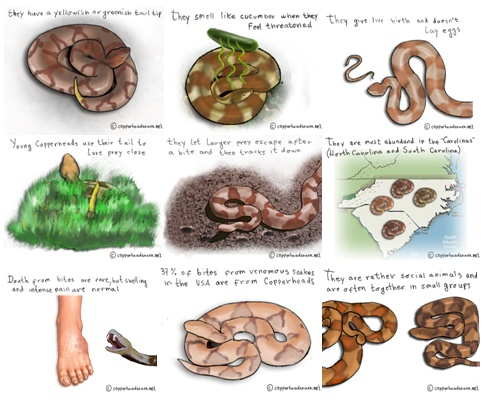
The Copperheadsnake Fact Cartoon

Myths about the Copperhead snake

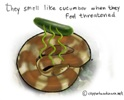
Cucumber

Please enlarge me

Some strange myths circulate about Copperhead snakes. One is that Black snakes can interbreed with Copperheads to make a venomous Black snake - the Black snake is probably a Rat Snake. Another one is that it smells like cucumber - which is generally not true, as they only secrete an odor resembling cucumber when they feel threatened such as when intruders bypass. The funniest myth about the Copperhead snake is that juvenile Copperhead snakes are more venomous than adults. Also, Copperhead snakes do not hunt in pairs as sometimes told.

Diet
Both juvenile and adult Copperheads feed on a diet of rodents, other reptiles and amphibians. During their first years, invertebrates are eaten as a protein rich supplement to the larger animals that may be to difficult to catch for the young snakes. As they grow older a larger and larger proportion of their diet become rodents.


Life cycle of Copperhead snakes

Live birth

Please enlarge me

Copperheads are viviparous, meaning that females give live birth rather than laying eggs. 3-10 snakes are born during late summer or early fall. Young snakes measure from 8-10 inches (20-26 cm).

The gestation period is approximately three months. However, sperm can be stored and snakes are capable of mating in autumn and give birth in early spring.

Overwintering

Copperhead snakes overwinter in dens, often together with snakes of other species.

Yellowish tail

Please enlarge me

Shedding skin and juvenile appearance

Young Copperheads have a yellowish or greenish tip on their tails, and they are grayer than adults.

The Copperhead snake replaces its skin 1-3 times annually. Juvenile Copperhead snakes shed their skin more often than adults because of their continuous expansion.

Also, the frequency by which Copperhead snakes change skin largely depends on the number of infections or injuries they acquired during the season. This is a self regulating feed-back system - whenever serious infections occur it replaces its skin.

Mating

Female Copperhead snakes reach sexual maturity when they are approximately four years old; males reach maturity around the same age. However, the exact age at which sexual maturity is reached in males remains to be investigated in detail4.

When the snakes emerge from their dens in early winter, they begin to seek out females for mating. The mating season is from February to April and the duration of the mating act is 3 to 8 hours. The transfer of sperm occurs when the male penetrates the female cloacae with one of it sex-organs. Female can store sperm for several months and only mates one male during a season.

Copperhead venom

The venom from Copperheads is cytotoxic and it functions by destroying cell tissue.

Tactics against larger animals

Copperheads are typical ambushers that because of their camouflage can approach prey without revealing their intentions. Young Copperheads are even more advanced as they can utilize their uniquely colored invertebrate looking tail that lures rodents and other animals to think it is an attractive snack.

Luring prey closer

Please enlarge me

Waiting for the venom to take effect

Letting prey escape to begin with

Please enlarge me

When they hunt larger prey they begin the hunt by injecting their venom into the body of the prey. As the venom is not sufficiently strong to kill most animals, they let it escape only to hunt it down shortly afterwards to swallow the now passive prey dead or alive.

Comments from the FaceBook comment field

Please visit the section: experiences for more help and answers to various discussions from the FB comment field.

Comment from: Selena, California

My mother in law was bitten twice in the foot yesterday in Texas. Is it normal for the leg to turn black all the way to the knee? As we understand no anti venom was administered. Is this normal? I guess the snake was two feet long. I am assuming the snake is young. We are in California and feeling very helpless. Does anyone have any suggestions or advise?

Reply from: Dominic, Texas

It sounds more like your mother in law was hit by a Rattle snake. Copperhead venom is a hemotoxic, just like rattlesnake venom, but acts differently. Copperhead venom tends to induce coagulopathy, which does two things - It both thins the blood, causing uncontrolled bleeding, and clots the red blood cells in an effort to cause a thrombosis (a blood clot). All of this is designed to weaken and immobilize the prey. If there is a large muscle mass to absorb the venom, there usually is not much, if any, necrosis in a Copperhead bite. Rattlesnake venom on the other hand is highly necrotic (it is flesh eating). If your MIL's leg is turning black in that large an area, I would definitely suspect a rattler over a copperhead. Unfortunately for her, the black is akin to gangrene, and is a sign that the flesh is already dead. She may have severe withering and scarring, or need amputation if it's really entrenched. I hope she's got an experienced medical team working with her! Sorry for the bad news. Also, antivenin is usually not given in the case of a Copperhead bite, so maybe I'm wrong and she's just having a particularly bad reaction. Was she treated at a rural hospital, where they see this kind of thing fairly often, or at a metropolitan hospital that might not have as much experience? Did anyone kill and bring the snake to the ER for identification? At two feet, you'd also be looking at an adult copperhead, but a young rattlesnake.

Comment from: Jason, Texas

I live in magnolia, TX, and we have killed 5 in the last 3 days - 9 total in the last month. We have found them all either climbing on our pasture fence or under water troughs. Can someone please tell me what exactly "lime" is? We live on land and have farm animals and two very small children and have been shaken up by how many we have found. Kids aren't able to play outside and worried about if they will start coming in my house. I have read up on them to have more knowledge but still not sure what to do. Any advice would help!

Reply from: Schelle, Texas

Lime is what you dust chickens with to prevent mites rite? I believe lots of farm & ranch people use the product for many things. Moth balls too, do we have snake removal here? Because there might be a breeding place on your property.

Reply from: Susan, Texas

Lime is an absorption agent, it absorbs moisture that is what it is designed for but has many uses but it does not repel snakes it's a wise tell. It can irritate them a little but it usually won't stop them I have tested the theory.

Reply from: Valerie, Texas

CATS!!!! The only answer!!!!!

Comment from: Ruby, California

I tried to kill one tonight in the chicken coop with a flat shovel but I missed and it went through a hole under the foundation of the chicken shed. Now what? This is the second Copperhead I've seen in the same general area. I'd hate for me or even one of the children to get bitten. What about the wasp spray? Would that kill them from a distance? Of course, the chickens would have to be a good distance away I'm guessing?

Reply from: Dona

Leave them alone and they will leave you alone. They are more likely going for the rats and mice you have because of the chicken feed.

References

1. Moski, H. A Large Litter of Copperheads (Agkistrodon contortrix mokeson) Copeia, Vol. 1954(1) pp. 67
2. Missouri Copperheads
3. Ernst, C. & R. Barbour. Snakes of North America (1989)
4. Lavones E.J. et al. Initial Experience With Crotalidae Polyvalent Immune Fab Antivenom in the Treatment of Copperhead Snakebite Toxicology 44(2) pp. 200-206 (2004)

Contact information

Contact. Please remember to REMOVETHIS between the (at) and the y.

Other Resources

Fact Sheet - Ohio Public Library
Ohio Division of Wildlife
University of Michigan


Privacy policy for http://www.copperheadsnake.net:

Third part advertisers may or may not use cookies and beacons that can provide them with information about your geographic location and IP address, as well as browser specific info and information about how many screen colors you have and how many pixels your screen has, - but not e-mail-address and name. The option of allowing cookies and beacons can be disabled in the privacy settings of your web browser.